
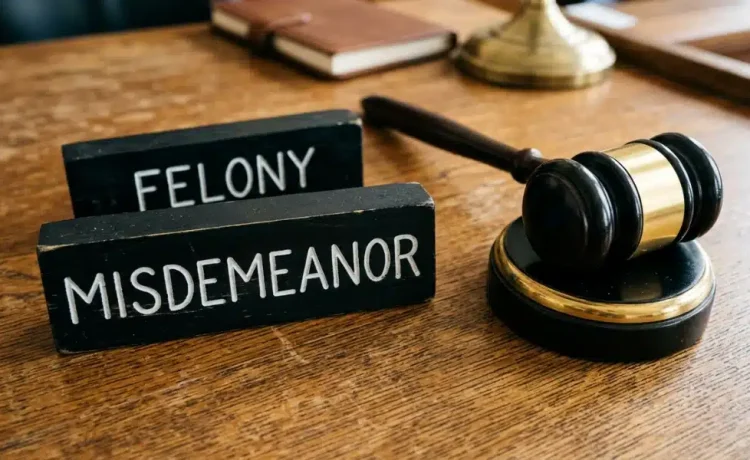
In the American legal system, the moment a formal criminal charge is filed, a crucial label is attached to the docket: misdemeanor or felony. To the uninitiated, the distinction might seem like an academic exercise in statutory grading or simply a question of how much time someone might spend behind bars.
The reality is far more pervasive. That single word stamped across a case file acts as a permanent fork in the road. While both classifications indicate a breach of criminal statutes, they represent entirely different universes of state power, personal consequence, and long-term disenfranchisement.
Understanding the dividing line between these two offenses requires looking past the courtroom proceedings and examining how the label reshapes an individual’s civic, professional, and personal future for decades.
The Statutory Dividing Line: Time, Facilities, and Severity
The foundational boundary between a misdemeanor and a felony rests on the potential duration and location of incarceration.
A misdemeanor is historically classified as a lesser criminal act. In nearly every state and under federal law, the maximum statutory term of incarceration for a misdemeanor does not exceed one year. Furthermore, that time is almost universally served in a local city or county jail rather than a state penitentiary. Jails are designed for short-term stays, pretrial detention, and municipal sentences, generally keeping individuals closer to their communities and families.
A felony represents the most serious tier of criminal offenses. By statutory definition, a felony carries a potential prison sentence exceeding one year, stretching up to life imprisonment or capital punishment in states where the death penalty remains active. Incarceration for a felony is served in state or federal prison facilities. These institutions are closed, high-security environments often located far from an inmate’s home county, purposefully structured for long-term punitive isolation.
Both categories are internally stratified into classes or levels. A state might divide misdemeanors into Class A, B, and C offenses, where a Class A offense carries up to a year in jail and a Class C might involve only a fine or thirty days. Felonies are similarly stratified, typically running from Class E (the lowest level, often involving non-violent property offenses) up to Class A or Level 1 (reserved for homicide, kidnapping, and treason).
Despite this spectrum, the formal barrier separating the highest misdemeanor from the lowest felony remains the single most consequential jurisdictional threshold in criminal law.
The Courtroom Machinery: Pretrial Detention and Procedural Rigor
The structural divide between misdemeanors and felonies manifests long before a verdict is delivered or a plea agreement is signed. The entire procedural machinery accelerates or intensifies depending on the charge.
In misdemeanor cases, the procedural path is generally expedited. An individual is typically arrested and released on their own recognizance or granted low cash bail within hours, sometimes receiving merely a summons or citation to appear in court on a specific date. Arraignments are swift, and resolutions through diversion programs, community service, or probation are frequently available at early calendar calls.
Felony proceedings, by contrast, engage the full procedural artillery of the state. Because the stakes involve multi-year state prison commitments, constitutional protections operate with greater formality:
-
Indictment and Preliminary Screenings: Many jurisdictions require felony charges to pass through a grand jury for a formal indictment, or require a comprehensive preliminary hearing where a judge determines if the state has met its burden of probable cause.
-
Bail and Pretrial Detention: Bail amounts for felonies are dramatically higher, frequently pricing defendants out of pretrial freedom. Extended stays in pretrial detention place immense pressure on defendants, often eroding their employment and housing before they ever have the chance to contest the charges.
-
Sentencing Enhancements: Felony statutes routinely incorporate habitual offender laws and mandatory minimum sentences. A previous felony record can double statutory sentencing ranges or trigger three-strikes provisions that take judicial discretion off the table entirely.
Civic Disenfranchisement: The Stripping of Democratic Identity
Perhaps the starkest divergence between a misdemeanor and a felony lies in how the conviction alters an individual’s constitutional standing as an American citizen.
A misdemeanor conviction, in the overwhelming majority of circumstances, leaves your civil rights untouched. You retain the right to vote, the right to hold public office, the ability to serve on a jury of your peers, and your constitutional right to keep and bear arms.
A felony conviction, however, fundamentally redefines your relationship with the state through civil death—the statutory revocation of basic democratic rights.
The Right to Vote
Felony disenfranchisement policies vary drastically across the country, creating a complex patchwork of civil status. In a handful of states, voting rights are never lost, even while incarcerated. In others, voting rights are automatically restored upon release from prison, or upon the completion of all terms of probation and parole.
Yet in several states, a felony conviction results in permanent disenfranchisement unless an individual receives an explicit, individualized restoration of rights from the governor or a state pardons board. Millions of American citizens remain barred from the ballot box solely because of a past felony conviction.
Jury Service and Public Office
A felony conviction routinely disqualifies an individual from serving on state or federal juries for life, or requires an arduous restoration process. This exclusion permanently removes individuals with criminal records from the judicial decision-making process, directly affecting the demographic composition of juries.
Similarly, many state constitutions explicitly prohibit anyone convicted of an infamous crime or felony from running for elected office, foreclosing an entire avenue of public engagement.
Second Amendment Rights
Under federal law (18 U.S.C. § 922(g)), any person convicted of a crime punishable by imprisonment for a term exceeding one year is permanently prohibited from shipping, transporting, possessing, or receiving firearms or ammunition.
This federal firearm ban applies automatically upon the entry of a felony judgment, regardless of whether the underlying offense involved violence. A conviction for felony insurance fraud or non-violent grand larceny carries the exact same permanent Second Amendment disqualification as an armed robbery conviction.
While certain misdemeanors involving domestic violence trigger a similar federal firearms prohibition under the Lautenberg Amendment, general misdemeanors carry no such firearm disability.
The Economic Cliff: Professional Licensure and Modern Hiring Practices
When applying for employment, the distinction between a misdemeanor and a felony often spells the difference between an uncomfortable conversation and an immediate, automated rejection.
While progressive legislation such as ban-the-box initiatives has removed criminal history questions from initial job applications in numerous jurisdictions, background checks remain standard procedure during the final hiring phase. Employers routinely distinguish between the two classifications:
Commercial and Corporate Employment
Corporate human resources policies frequently maintain strict internal guidelines regarding background check flags. A five-year-old misdemeanor for reckless driving or trespassing is often treated as a momentary lapse in judgment, easily mitigated by a strong interview, solid references, or a clean subsequent record.
A felony, however, frequently triggers an institutional stop. Risk-averse legal departments, concerned about potential negligent hiring liability, regularly implement blanket policies against hiring individuals with felony records, particularly in positions that handle cash, intellectual property, sensitive data, or customer interactions inside private residences.
Professional Licensing Boards
The modern American workforce is heavily credentialed. Occupations ranging from registered nursing, legal practice, and certified public accounting to cosmetology, real estate, and general contracting require state licenses.
State regulatory boards exercise broad statutory discretion under moral turpitude and character requirements:
-
Healthcare: State medical and nursing boards rarely grant or maintain licenses for individuals with felony convictions, particularly those related to controlled substances, theft, or assault, viewing them as an unacceptable risk to patient safety.
-
Finance and Real Estate: The Financial Industry Regulatory Authority (FINRA) and state insurance commissions subject applicants to statutory disqualifications for felony offenses, largely barring individuals from securities trading, mortgage origination, and fiduciary roles.
-
Trade and Transportation: A felony conviction can permanently disqualify a driver from obtaining a Commercial Driver’s License (CDL) with specific endorsements, such as hazardous materials, or prevent workers from obtaining the Transportation Worker Identification Credential (TWIC) required to work in maritime ports and secure logistical facilities.
While a misdemeanor might trigger a board review or a probationary license period, a felony routinely forms a statutory barrier that terminates a professional career before it starts.
The Domestic Sphere: Housing, Credit, and Family Stability
The downstream consequences of a criminal conviction inevitably spill into private domestic life, destabilizing an individual’s immediate support network and material security.
Rental Housing and Eviction
Private landlords and corporate property management companies routinely screen applicants using criminal background aggregation services. Given low vacancy rates and high demand in urban rental markets, property managers routinely apply exclusionary criteria. A felony record—regardless of how old it is or the underlying nature of the act—remains one of the most common reasons for a summary denial of a rental application.
The consequences are even sharper in federally subsidized housing. Local public housing authorities operating under federal guidelines possess broad authority to deny admission or evict entire households if an occupant has a felony record, particularly concerning violent or drug-related offenses.
An individual returning from prison cannot simply move back in with their family if that family resides in public housing, forcing them to choose between family homelessness or personal displacement.
Higher Education and Student Support
While access to higher education has improved with the gradual removal of criminal history questions on standard university admissions forms, a felony conviction continues to create institutional friction.
Certain academic tracks—especially education, social work, nursing, and clinical psychology—mandate practical field placements, internships, or student-teaching rotations in secure institutions, hospitals, or public schools. Even if a university admits a student with a felony conviction, regional school districts or healthcare facilities may legally refuse to clear that student for the clinical hours required to graduate.
Furthermore, while changes in federal legislation have restored eligibility for Federal Pell Grants and federal student loans to many individuals with criminal records, institutional scholarships, campus housing access, and private student lenders often maintain strict criminal history exclusions.
Immigration Ramifications: Removal, Inadmissibility, and Moral Turpitude
For non-citizens residing in the United States—including lawful permanent residents (green card holders), temporary visa workers, and undocumented immigrants—the distinction between a misdemeanor and a felony takes on existential dimensions.
Immigration law is an autonomous federal domain that does not always track state definitions of criminal severity. However, the presence of a felony on an immigrant’s record dramatically escalates the likelihood of immigration detention and mandatory removal:
-
Aggravated Felonies: Under immigration law, the term aggravated felony is a statutory concept that encompasses dozens of offenses, including crimes that a state may classify as relatively minor. If an offense is categorized as an aggravated felony under immigration statutes, deportation is virtually mandatory, relief from removal is unavailable, and the individual faces a permanent bar from ever returning to the United States.
-
Crimes Involving Moral Turpitude (CIMT): A non-citizen convicted of a CIMT committed within five years of admission where the potential sentence is one year or longer faces immediate deportability. A standard state misdemeanor with a maximum sentence of 364 days can protect an individual from this rule, whereas a felony charge based on identical conduct instantly triggers the statutory deportation threshold.
Even when a misdemeanor does complicate an immigration application, legal pathways for waivers of inadmissibility, discretionary relief, and cancellation of removal frequently remain accessible. A felony conviction often shuts those statutory doors permanently.
The Strategy of the Plea: Wobblers and Record Relief
Given the immense disparity between these two classifications, the central focus of defense counsel in serious criminal matters is often not merely winning an outright acquittal, but preventing a felony from ever attaching to the client’s permanent record.
The Dynamics of Plea Bargaining
In the high-stakes environment of plea negotiations, prosecutors frequently utilize the severity of felony classifications as leverage. Conversely, defense attorneys leverage mitigating factors, evidentiary weaknesses, and alternative rehabilitation programs to secure charge reductions.
In states like California, certain offenses are classified as wobblers—crimes that statutory law permits prosecutors to charge, or judges to sentence, as either a felony or a misdemeanor depending on the circumstances of the case and the defendant’s background. Successfully litigating a wobbler down to a misdemeanor at the preliminary hearing or sentencing phase preserves the defendant’s civil standing and protects them from the lifelong disabilities of a felony record.
Expungement, Sealing, and Pardons
The ability to eventually clean an official criminal history and move forward without a public record is heavily determined by the initial conviction grade:
-
Misdemeanors: Most states offer relatively accessible statutory pathways for expunging or sealing misdemeanor records. After completing a short probationary period, paying court-ordered fines, and remaining crime-free for a statutory waiting period—typically one to three years—individuals can often have their misdemeanor records shielded from standard commercial background checks.
-
Felonies: Sealing or expunging a felony is an exceptionally high legal climb, and in many jurisdictions, it is statutorily impossible for wide categories of offenses. Crimes of violence, sexual offenses, and major economic crimes are routinely excluded from expungement statutes by default. For those individuals, the only remaining legal remedy is an executive pardon from a governor or the President—a discretionary measure granted to only an infinitesimal fraction of applicants each year.
The line separating a misdemeanor from a felony is not simply a technical detail regarding months spent in a cell. It is a defining legal boundary that dictates where you can live, what professions you can enter, whether you can raise your voice at the ballot box, and whether you remain a full civic participant in American society.